Friday, August 31, 2012

Writing Our Names

What is one of the most important things that Kindergarteners need to learn to write? Their names, of course! You have to know how to write your name in order to mark something as yours, find something that is yours, and recognize your name in print in all kinds of places!

Today we did some fun centers to help us learn how to do all of those things! We had three different centers for 8 minutes each and used all kinds of important skills like printing, stamping, and using our gross motor skills and muscles to mash up play dough!

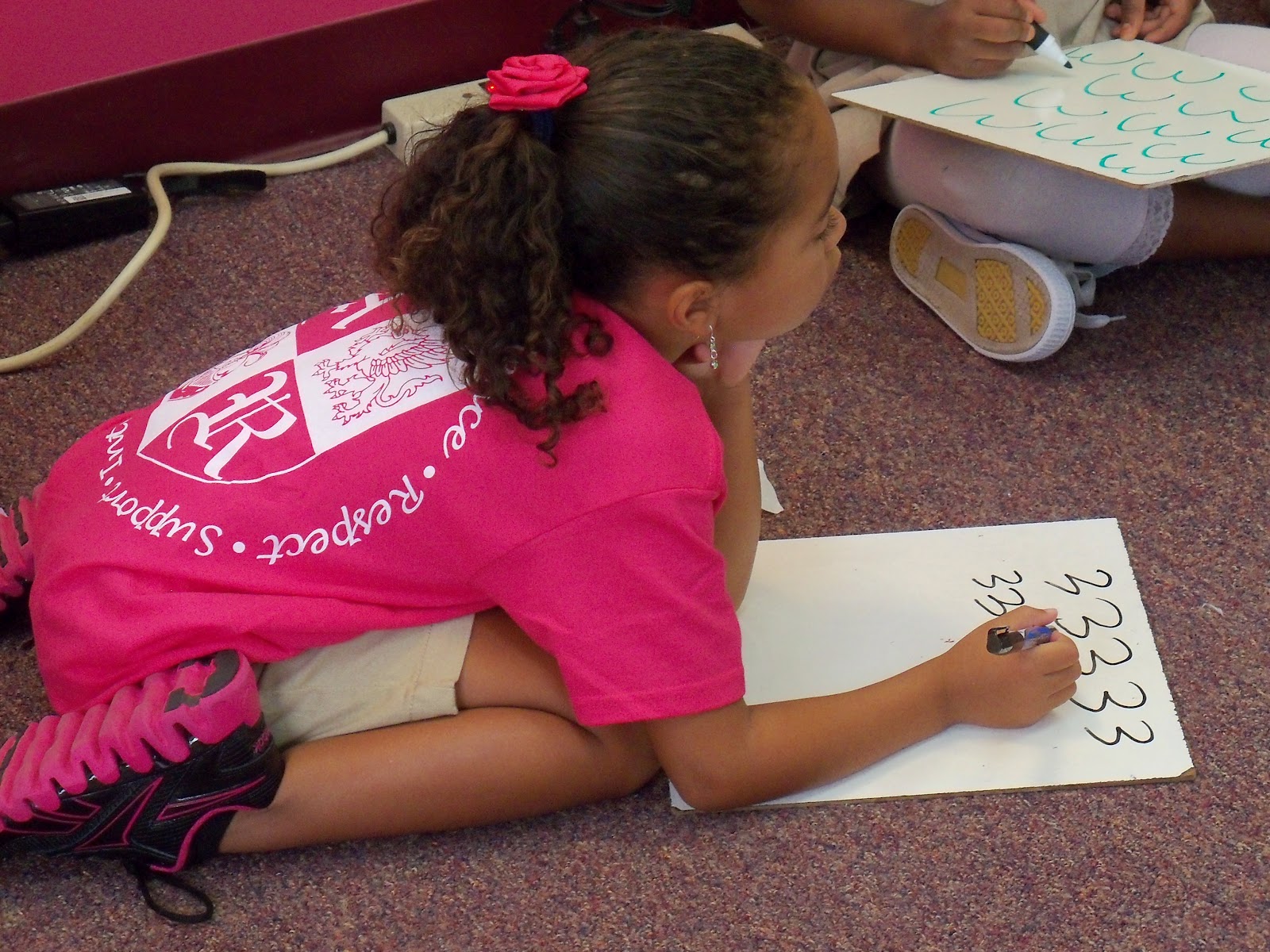
At one center, students were given a copy of their name in highlighter and asked to trace and copy it as many times as they could. This gave children who are not quite ready to write their names on their own a model to follow. Those who are able to write their names had a chance to practice on their own.


At another center, students were asked to roll out play dough and cut out their names using cookie cutters. This gave students a great chance to practice using all of the muscles in their hands to create their names!

At our third center, students used stamps to make their names. This center gave children the chance to practice manipulating small objects to make their name.


Each of these centers gave students the opportunities to use their hands and muscles in different ways to make their names. It gave hands-on (kinesthetic) learners the chance to manipulate objects to make their name and also gave students the chance to practice writing as well as spelling their names.

What a fun way to learn!

Monday, August 27, 2012

Beginning Math

This week we have been learning about the numbers 1-5. Each day we learned about a different number and how to count and represent it.

We started by learning how to count the numbers. We used counters to practice one to one correspondence as we counted. We also discussed different ways to represent what we counted. We might color in boxes, use counters, or draw pictures.

Next we learned what the number looked like in both number and word form. We practiced writing our numbers using skywriting and dry erase boards. We also used our fingers to "vote" to answer "how many" questions. This was a great introduction to counting and numbers and will be a great thing for us to build on as we move on in our math curriculum.


Welcome to Letterland

Over the past few weeks, we have been learning lots about Letterland! We have met lots of new characters and learned about the sounds that they make. Each day we "meet" the character by using the "Living ABC" software on our smartboard. It takes us to the character's house and we learn about the different things that they do and like based on their sound. For example, Firefighter Fred fights fire with foam, Lucy Lamplight lives in the Letterland lighthouse, and Harry Hatman gets horrible headaches.


Each day after we learn about the character, we make an alphabet line and complete a word sort for review of old characters and practice with new characters. There are vocabulary cards that go along with each character. I pass out the cards to the students in the class and we sort them based on which letterland character makes the sound. This is great practice for beginning sounds! When we are finished, the children who are playing the characters give a sentence with their character. They say their character name and the words that they make. This is great review of sounds we've already covered. It is a fun and active way to practice letters and sounds.

Writer's Workshop

This week we began learning about writer's workshop. We learned about how we will sit at writer's workshop and how we will share with partners. We also learned about using our imaginations to illustrate the stories that we have to tell.


As an example of this, we read Harold and the Purple Crayon. In the story, Harold goes on an adventure in his imagination and he illustrates it as he goes. We read through the story once and discussed how Harold visited all of the places and how he used his imagination to create the places he wanted to go. Then we read through it again and the children came up and illustrated Harold's story.


Here is our version of Harold and the Purple Crayon!


One evening, after thinking it over for some time, Harold decided to go for a walk in the moonlight. There wasn't any moon, and Harold needed a moon for a walk in the moonlight.  And he needed something to walk. He made a long straight path so he wouldn't get lost. And he set off on his walk, taking his big purple crayon with him. But he didn't seem to be getting anywhere on the long straight path. So he left the path for a short cut across a field. And the moon went with him. The short cut led right to where Harold thought a forest ought to be. He didn't want to get lost in the woods. So he made a very small forest with just one tree in it. It turned out to be an apple tree. The apples would be very tasty, Harold thought, when they got red. So he put a frightening dragon under the tree to guard the apples. It was a terribly frightening dragon. It even frightened Harold. He backed away.

His hand holding the purple crayon shook. Suddenly he realized what was happening. But by then, Harold was over his head in an ocean. He came up thinking fast. And in no time he was climbing aboard a trim little boat. He quickly set sail. And the moon sailed along with him. After he had sailed long enough Harold made land without much trouble. He stepped ashore on the beach wondering where he was. The sandy beach reminded Harold of picnics. And the thought of picnics made him hungry. So he laid out a nice picnic lunch. There was nothing but pie. When Harold finished his picnic, there was quite a lot left. So Harold left a very hungry moose and a deserving porcupine to finish it up.

And off he went, looking for a hill to climb to see where he was. Harold knew that the higher up he went, the farther he could see. So he decided to make the hill into a mountain. If he went high enough he thought he could see the window of his bedroom.
He hoped he could see his bedroom window from the top of the mountain. But as he looked down over the other side, he slipped. And there wasn't any other side of the mountain. He was falling in thin air. But luckily he kept his wits and his purple crayon. He made a balloon and he grabbed on to it. And he made a basket under the balloon big enough to stand in. He had a fine view from the balloon, but he couldn't see his window. He couldn't even see a house.
So he made a house, with windows. And he landed the balloon in the grass in the front yard. None of the windows was his window. He tried to think where his window ought to be. He made some more windows.
He made a big building full of windows. He made lots of buildings full of windows. He made a whole city full of windows. But none of the windows was his window. He decided to ask a policeman. The policeman pointed the way Harold was going anyways, but Harold thanked him. And he walked along with the moon, wishing he was in his room and in bed.


Then suddenly Harold remembered. He remembered where his bedroom window was when there was a moon. It was always right around the moon. And then Harold made his bed. He got in it and he drew up the covers. The purple crayon dropped on the floor. And Harold dropped off to sleep.

Saturday, August 18, 2012

Welcome to Kindergarten!

We have had a great first week at school! On Wednesday everyone seemed a little bit nervous, but by the end of the day everyone was having a great time! We started out our day with an icebreaker where the children told different things about themselves and they were surprised to see how much they had in common! Several of the children knew each other from preschool and others made new friends immediately! We took a tour of our school and learned where all of the important people and places in our school are located. At the end of a busy day, the children had some time to play with and get to know the I new friends better. All in all it was one of the best first days ever!

Tuesday, May 15, 2012

If you give a first grader an idea, a pencil, and some paper!


Last week we spent a while reading what I like to call the "If You Give" books. We read several different ones and used graphic organizers to organize our thoughts about the books. Each day we read a book and then completed a different type of organizer about it. We varied the way that we did these; sometimes we did them as a class, sometimes the children did them on their own and then we shared as a class. 

We started on Monday by reading If You Give a Mouse A Cookie. After reading the story, the children looked at an organizer about cause and effect. The children had to think about what the cause was and then the effects of this. In this case, the cause was giving the mouse a cookie and the effects were all of the things that came afterwards.

Tuesday we did a "Sees, Does, Thinks, Feels" Organizer about the story, If You Give A Moose A Muffin. This organizer helped us to recognize events in the story as well as to empathize with the character to infer what he may have been thinking or feeling. These details often are not writing out explicitly in the text and inference is a great skill for the children to begin working with.
Wednesday we completed an organizer called "Question It!". The children had to identify the Who, What, When, Where, Why, and How's of the story If You Give a Pig a Party. This emphasized the key concepts of character, setting, and plot. Children were able to pick out the different aspects of the story.

Thursday we completed a "Double Bubble" comparing If You Give a Cat a Cupcake and If You Give a Dog a Donut.  The children had to compare and contrast the two stories, picking out key details of each.

Friday we gave writing our own "If You Give" stories a try. We read If You Give a Pig a Pancake and then the children were asked to write their own story that was similar to the ones we read in class. We discussed what each story had in common. We decided that each story had some type of animal that got something that then reminded him of other things and so on until it circled back around. We nicknamed these "circle" stories because at the end they always end up back where they started. The children did a great job coming up with new characters and stories. This is a great way for them to practice using author's voice and craft.

Here are some examples... feel free to come check them out in our hallway as well!


Friday, May 11, 2012

The Wild Things


I was very saddened to hear that Maurice Sendak had passed away earlier this week. His book, Where the Wild Things Are,  is one of my very favorites!

In honor of this wonderful author, I did a little activity with our class. I wanted to share this great story with them so that they could love it as much as I do!

We started by reading the story. The children loved it! That max is quite a character!

Then I had the children write what they thought would happen next in the story.
I got all kinds of wonderful answers! Several children thought that Max would eat his supper and then go to sleep and dream about the Wild Things. Others thought that Max would eat his supper and then go back to visit the Wild Things to have another Wild Rumpus. One even suggested that maybe the Wild Things would come to visit Max at his house.

These were great responses to the story! It not only showed me the students' ability to use basic capitalization, punctuation, and sentence structure, it also gave them the chance to participate in writing by using an author's model of language and extending the model.

They also demonstrated their abilities to use words that name characters and settings and  tell action and events in simple texts.

Who knew that you could learn so much from just one book? That's why it is such a great story!